
Safeguarding Policy
Bubble and Speak is a Community Interest Company that offers a convivial space where children under four years of age and an accompanying adult (mother, father, grand-parent, nanny, hereinafter ‘carers’) can meet to talk and play. It is not a crèche, nor a day care centre, nor a place for consultations. It runs drop-in sessions hosted by ‘welcomers’ (either self-employed contractors of Bubble and Speak or volunteers), a title that challenges traditional roles in mental health (nurse, educator, psychologist, social worker, psychiatrist, child psychiatrist, etc) in that it requires distance from a therapeutic, pedagogical or counselling approach. Instead, it requires a psychoanalytic stance to the extent that it implies a reference to unconscious processes.
The “welcoming function” at Bubble & Speak rests on the possibility offered to every participant - welcomer, child, parent, carer - to be welcomed by the community of people that is present in the space. The very functioning of the space invites each person to find their place within it, not in response to norms, or expectations, but in accordance with their own desire. This calls to a personal engagement for each and every participant. The nature of our work is such that it cannot be done online. In the relatively unstructured yet safe environment we provide, questions arise that engage the unconscious.. For instance, hearing an adult speaking in earnest to a baby, or a child piping up with the answer to a question that intimately concerns him or her. The effectiveness of this approach is reliant on the open, trusting and non-judgemental atmosphere that we aim to create.
Safeguarding refers to the right to live in safety, free from abuse and neglect. It requires that people and organisations work together to avert the risks and prevent the experience of abuse or neglect, while at the same time making sure that individual wellbeing is promoted. To these ends the organisation will create a culture of inclusiveness and consideration, a space that is safe for children and adults to enjoy, and in which any harm detected or disclosed, or issues to do with sharing, or with aggressive or anti-social behaviour, will be responded to with care, concern and in accordance with the safeguarding procedures Bubble and Speak has adopted and developed as appropriate and that are specified in this document.
Bubble and Speak is committed to providing an inclusive environment for children, their carers, our welcomers and our visitors. We believe everyone has a responsibility to promote the welfare of children regardless of their age, disability, race, religion, or sex, to keep them safe, and to act in a way that protects them. We also recognise that some children may be additionally vulnerable because of the impact of discrimination, family circumstances, their level of dependency, specific communication needs, or other issues.
The procedures detailed here address safeguarding provisions for children; for vulnerable adults who may accompany them; and for welcomers and visitors to the organisation.
The designated Safeguarding Lead for Bubble and Speak CIC is Daniela Oliveira Grund.
The Deputy Safeguarding Lead for Bubble and Speak CIC is Kristina Valendinova.
Background to our Safeguarding Procedures
Our safeguarding policies and procedures have followed guidelines published by the NSPCC, from whom we have also obtained guidance specific to our service. They have also been developed with reference to the following:
i. The UN Convention on Human Rights, Part 1, Article 3, Section 1 which states that “in all actions concerning children, whether undertaken by public or private social welfare institutions, courts of law, administrative authorities or legislative bodies, the best interest of the child shall be a primary consideration”. Further, the General Comment No.14 (2013) on the right of the child to have his or her best interest taken as a primary consideration (Article 3, par.1), distributed by the UN Convention on the Rights of the Child (29 May 2013), states that it is a dynamic concept that requires an assessment appropriate to the specific context.
ii. Relevant government legislation and guidance, including Working Together to Safeguard Children (Department for Education, 2018) which states that:
everyone who works with children has a responsibility for keeping them safe;
everyone who comes into contact with children and families has a role to play in sharing information, if so recommended or required, and identifying concerns when they arise.
iii. Section 11 of the Children Act 2004 which places a statutory duty on certain agencies (including local authorities, NHS services and trusts, police and probation services) to co-operate to safeguard and promote the welfare of children.
iv. A document produced by the Information Commissioner’s Office entitled Children and the GDPR.
Welcomer Recruitment
Work with Bubble and Speak is open to those with a psychoanalytic background who subscribe to our project’s fundamentals and principles. Prospective welcomers contact the organisation through our email address: hello@bubbleandspeak.org.uk with an expression of interest. Applicants are invited to provide a CV and details of two referees. Suitable applicants are invited to be interviewed by a director of Bubble and Speak and an experienced welcomer. The interviewers then report on the interview and discuss selection with our team, who together take a decision regarding recruitment.
References are sought from selected candidates who must provide a current, clear enhanced DBS check and agree the terms of our Consultancy or Volunteering Agreement which includes participation in team meetings and group supervisions, abiding by the organisation’s Code of Conduct, and undergoing an induction and training. Every Welcomer is required to read our Safeguarding Policy and Procedures Manual, Data Management Policy and Code of Conduct, and to undergo a level 3 Safeguarding training. DBS checks must be renewed every three years. In addition, welcomers receive annual in-house bespoke training on Bubble and Speak safeguarding policies and procedures.
Social Media
Bubble & Speak has an online presence in the form of a website (https://bubbleandspeak.org.uk/) and on several social media applications (including Happity, Instagram, LinkedIn) which are vital to advertising and communicating about the service. As part of its commitment to preserving the confidentiality of all service users, while use is made of images including the building, equipment and toys, and the team, strictly no photographs of children or carers using the service are allowed to be taken.
Procedures for the safeguarding of children
Mainstaining a safe environment
Bubble & Speak is committed to providing a physical environment that recognises the ages and stages of development of the children for whom the service is offered. These measures include:
that the ratio of adults to children, following NSPCC recommended guidelines, will be not less than one adult to three children;
that any furniture and toys are age appropriate;
that any electric plugs in the vicinity are child safe;
that the cleanliness and hygiene of the space in which the service is offered will be maintained;
that there are suitable disabled access and baby-changing facilities;
that simple first aid measures and equipment are easily available, if needed, for minor cuts and abrasions. In the event of more serious injury, welcomers are advised to call 111 in the first instance. If an emergency, call 999. The nearest Hospital is The Whittington NHS Trust, Magdala Avenue, London N19 5NF, Tel. 020 7272 3070 (main switchboard).
Given the age of the children using the service some physical contact is inevitable but should not be sought or engaged in for any other reason than to support children to accomplish an activity.
Recognising concerns about a child’s welfare
Bubble & Speak works with very young children, under four years of age, most of whom are pre-verbal, and their caregivers. Expectant parents sometimes also join our sessions. It is important that team members be aware of, and vigilant about, their child safeguarding responsibilities.
Abuse of children can take different forms. These include:
Physical abuse, including hitting, shaking, throwing, poisoning, burning or scalding, or otherwise causing physical harm to a child, or indeed failure to protect a child from such harm. Some signs of physical abuse are:
unexplained or untreated injuries or burns
bald patches
withdrawal from physical contact
limbs covered inappropriately, e.g. in hot weather
admission of punishment which may appear excessive
Emotional Abuse, which refers to persistent emotional ill treatment of a child such as to cause severe and persistent adverse effects on the child’s emotional development. Some signs of emotional abuse are:
over-reaction on the part of a child to mistakes or accidents
excessive fearfulness in the face of new situations
excessive passivity or aggression
Sexual Abuse involves forcing, enticing or grooming a child to take part in sexual activities, whether or not the child is aware of, or consents to, what is happening. It may involve physical contact but may also include non-contact activities, such as looking at, or involving children in the production of, pornographic material, or watching sexual activities, or encouraging children to behave in sexually inappropriate ways. Signs of sexual abuse include:
over familiarity with adults or provocative behaviour
withdrawal and introversion
difficulty with peer relationships
Neglect, which is characterised as a persistent failure to meet a child's basic physical and/or psychological needs, likely to result in the serious impairment of the child's health or development. This can include failure to provide adequate food, shelter and clothing, failure to protect a child from physical harm or danger, or the failure to ensure access to appropriate medical care or treatment. Signs of neglect can include:
constant hunger
poor state of clothing
poor hygiene
being emaciated
tendency to run away
compulsive stealing or scavenging
Responding to concerns about a child’s welfare
In the setting of Bubble and Speak it is important to note that it is unlikely that attention to abuse will arise from verbal disclosure on the part of a child, although that remains a possibility. It is also important to be aware that signs of neglect might arise because of the family’s circumstances and the unavailability of support for the family. Welcomers therefore need to be attentive both to possible signs of distress and to the possible reasons for that distress.
In the event that a child seems to show signs of abuse or neglect, but the threat is not deemed to be an emergency, the concern should be logged in the Bubble & Speak Safeguarding Incident Logbook, including the following information:
the date and time of the incident /disclosure
the name and role of the person logging the concern or to whom the concern was originally reported and their contact details
the names of all parties who were involved in the incident including any witnesses
the name, age and any other relevant information about the child who is the subject of concern (including, if available, information about their parents or carers and any siblings)
what was reported, noted, said or done, and by whom
any action taken to look into the matter
any further action taken.
The welcomer noting a concern in the Safeguarding Incident Logbook should also speak to the safeguarding Lead or Deputy Lead, or to a Director of the organisation if neither of them are available, for further advice and support as soon as possible.
Entries in the Safeguarding Incident Logbook enables welcomers to identify, and importantly to monitor, concerns on an ongoing basis. The individuals of concern should be encouraged to continue to take part in Bubble & Speak sessions.
Each time that the record of attendance for a session is made, the welcomer making that entry must also check the Safeguarding Incident Logbook to monitor the attendance and condition of any child or carer about whom there has been concern. The Safeguarding Incident Logbook is also reviewed every month in team meetings.
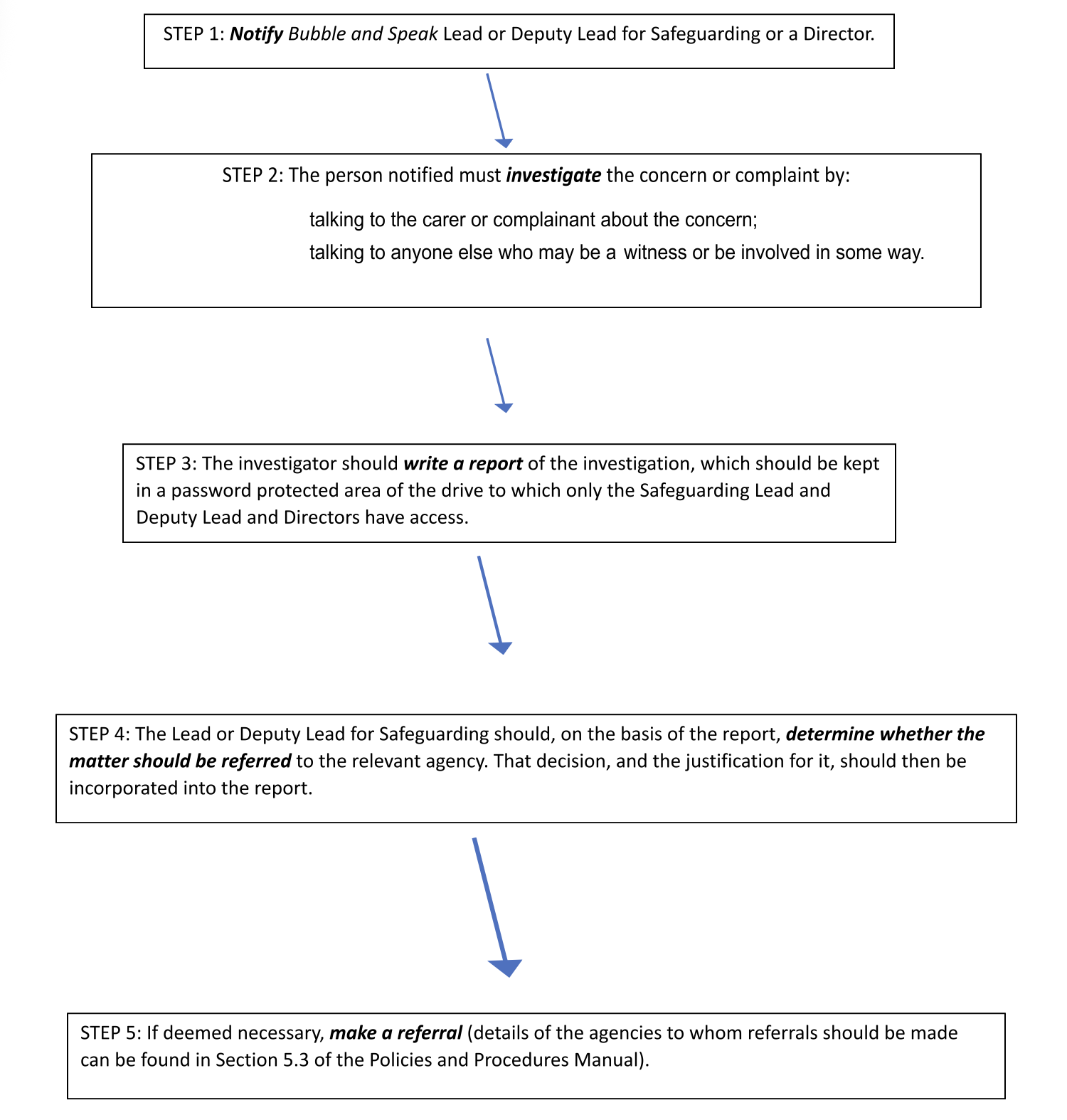
In the event that the monitoring of concern about a particular child indicates that a safeguarding referral may be appropriate, the Safeguarding Lead, Deputy Safeguarding Lead or one of the Directors will need to investigate the concern, in the first instance by talking to the carer or complainant about the concern. This may well require a confidential, empathic conversation with the carer to elicit the information required to make a referral. Anyone else present who may have been a witness or involved in some way should also be spoken to. As welcomers work on a rota, investigation should include a meeting of welcomers in order to gather together any incidental information that may have been garnered in sessions over time e.g. where the child goes to school, family circumstances.
Brickworks Community Centre, which provides accommodation for Bubble & Speak, will make available a confidential space, on an ad hoc basis, to enable private, confidential conversations with a service user if required. At this point, further data (full name, address, and age of child, as well as contact details of the child's parent or carer) will be sought to enable a referral to be made, should that be deemed necessary.
The person undertaking the investigation should produce a report detailing the concern and related investigation, including:
the name and role of the person making the report (and their contact details)
the names of all parties who were involved in the concern or incident, including any witnesses
the name, age, address and any other relevant information about the child who is the subject of concern (including, if available, information about their parents or carers and any siblings)
details of the investigation undertaken
any action taken.
The report must be factual. Any interpretation or inference drawn from what was observed, said or alleged will be clearly reported as such.
In considering making a referral the following should be taken into account:
the child’s safety and wellbeing, now and in the immediate future;
in the event of an accompanying adult making a disclosure, that person’s wishes and preferred outcome;
whether the abuse is a one-off incident or repeated, and whether others are liable be affected (adults and/or children);
who is suspected of being implicated in the abuse;
whether a crime may have been committed.
The report of the investigation, including the outcome as to whether or not it has been decided to make a referral to a relevant agency and why, should be saved in a confidential, password protected space on Google Drive to which only the Lead and Deputy Lead for Safeguarding or a Director.
The Safeguarding Lead or their Deputy should then make the appropriate referral, if that is indicated in the report. This is the only circumstance in which information held by Bubble & Speak would be shared with a third party.
For details of our policy regarding data protection please see the Bubble & Speak Data Management Policy
The summary procedure for when a referral is being considered is as follows:
The following agencies should be considered for referral:
Islington Children’s Services Contact Team (CSCT), 020 7527 7400, referrals to csctreferrals@islington.gov.uk who offer services including:
Family support in the community
Health and mental health services
Children’s Social Care - services to protect and safeguard vulnerable children
Islington Adult Social Care for adult services if considered appropriate, 020 7527 2299 (9-5pm, Monday to Friday) 020 7226 0992 (at all other times)
The police, if a crime has been committed or a suspicion of a crime has been committed, on 999 for emergency or 101 if not considered an emergency
If there is evident, immediate threat to the child, 999 should be called immediately.
If at any time there is uncertainty as to how to proceed, NSPCC can be contacted for support and information:
NSPCC Helpline on 808 800 5000
Email: help@nspcc.org.uk
Procedures for the safeguarding of adults
Identifying abuse
As with children, abuse of adults may take different forms and can include:
Physical Abuse, which may include pain, injury or other physical harm including physical domestic violence;
Neglect/Self-Neglect, which may include inability to feed or care for oneself or the denial of basic human rights;
Psychological/Emotional Abuse which may include insults, bullying, threats, humiliation, ridicule;
Discrimination, which may include being treated differently based on the following: age, disability, gender reassignment, marriage and civil partnership, pregnancy and maternity, race, religion and belief, sex, sexual orientation;
Sexual abuse, which may include any sexual activity carried out without continued consent from the individual. This includes suggestive comments, showing people sexual images, touching, and groping as well as sexual activity.
Responding to concerns about an adult’s welfare
If someone is at immediate risk of harm or requires urgent medical attention, 999 should be called immediately.
If an adult service user reports abuse or there is reason to suspect abuse without there being evidence of an immediate threat, a concerned welcomer must speak to the Safeguarding Lead or Deputy Lead or one of the Directors for further advice and support as soon as possible. The person to whom the matter is reported should then:
investigate the concern by empathetic interview of the individual concerned, including asking them what they would like to be done about it, e.g. referral;
write a report of the matter based on the information available. The report, including the outcome as to whether or not it has been decided to make a referral to a relevant agency and why, should be saved in a confidential, password protected space on Google Drive to which only the Lead and Deputy Lead for Safeguarding or a Director.
consider whether referral is appropriate and make a determination as to whether the matter should be referred to another agency;
seek consent to report the concern if referral is deemed appropriate.
The following agencies should be considered for referral:
Islington Adult Social Care for adult services if considered appropriate, 020 7527 2299 (9-5pm, Monday to Friday) 020 7226 0992 (at all other times)
The police, if a crime has been committed or a suspicion of a crime has been committed, on 999 for emergency or 101 if not considered an emergency
In the event that consent is not gained and a decision to refer without the individual’s consent is made, defensible rationale should be included in the report, e.g., a criminal act has taken place; the individual is at risk of abuse from others/self, etc.
Responding to an allegation of abuse of a service user against a Bubble & Speak welcomer
The complaint should be reported to the Lead or Deputy Lead for Safeguarding or to a Director of the organisation.
The person to whom the complaint is made should investigate the complaint by interviewing the complainant, the worker and any witnesses.
A written report should be made of the investigation.
The Lead and Deputy Lead for safeguarding together should determine the outcome of the investigation.
If the complaint is upheld, a decision should be made as to whether the complaint is mild (a breach of the code of conduct without harm) or serious (a breach of the code of conduct which resulted in harm or abuse).
If the breach is deemed mild, the welcomer should be issued with a warning and required to undergo further training in Safeguarding.
If the breach is deemed to be serious, the welcomer should be dismissed from the organisation and consideration given as to whether a crime has been committed necessitating a report to the police.
Bubble & Speak as an organisation is aware of the Prevent Strategy, but the age of the children for whom the service is provided make it unlikely that it would ever be necessary to invoke implement its recommendations in this context.
Procedures for the safeguarding of Bubble & Speak welcomers and visitors
All Welcomers are expected to abide by the Bubble & Speak code of conduct.
Responding to allegations of abuse by a Welcomer against another team member
Bubble & Speak has a flat organisational structure so that there is little opportunity for abuse of a position of power or authority (bullying). Nevertheless, there are differences amongst welcomers with respect to how the organisation was established, longevity of involvement and age which may give rise to informal power differences amongst welcomers.
Where an allegation arises that a Bubble & Speak Welcomer may have abused or bullied another member of the team:
the complaint should be reported to the Lead or Deputy Lead for Safeguarding or to a Director of the organisation;
the person to whom the complaint is made should investigate the complaint by interviewing the complainant, the Welcomer and any witnesses;
a written report should be made of the investigation;
the Lead and Deputy Lead for safeguarding together should determine the outcome of the investigation;
if the complaint is upheld, a decision should be made as to whether the complaint is mild (a breach of the code of conduct without harm) or serious (a breach of the code of conduct which resulted in harm or abuse);
if the breach is deemed mild, the Welcomer should be issued with a warning and required to undergo further familiarisation with our Code of Conduct and training in Safeguarding;
if the breach is deemed to be serious, the Welcomer should be dismissed from the organisation;
if the complaint concerns a possible crime, the matter should be referred to the police.
Bubble & Speak is committed to ensuring that team members who whistle-blow in good faith will be protected from reprisals and victimisation consistent with the protections for whistle blowers provided under the Public Interest Disclosure Act 1998.
Data storage and protection
(for further information see our Data Management Policy)
Following the example of the long-established Maison Verte in France which has inspired our project, the information we record about service users is deliberately minimal, a decision which is aimed at encouraging a confidential atmosphere where people – and in particular people in difficult or disadvantaged circumstances who might otherwise feel unable to use more traditional, formal, note-taking, fee-paying services - can freely speak about anything of concern to them. This relative anonymity is a fundamental principle of the ethos of Bubble & Speak.
At the same time, Bubble & Speak is aware of our responsibilities with regard to both safeguarding and data protection and is committed to processing data in accordance with its responsibilities under the UK GDPR (see our Data Management Policy).
Bubble & Speak collects the following data from families and children participating in the sessions: child’s first name, age and sex, relationship of adult(s) accompanying the child(-ren), whether they have visited before. It should be noted that the information recorded is aimed at encouraging a confidential atmosphere where people can freely discuss any concerns they may have. The child’s name is written on a whiteboard for the duration of a session and deleted immediately the session ends.
Bubble & Speak also obtains the following personal information from applicants who wish to join our organisation as ‘welcomers’: name, postal address, email address, telephone number/s, CV, DBS check and references. That information, together with relevant interview notes, is kept in a protected area on Google Drive to which only the Directors of Bubble & Speak have access.
All data collected is held securely and treated with utmost confidentiality and in accordance with the Guide to the UK General Data Protection Regulation (UK GDPR). Consistent with NSPCC Child Protection Records Retention and Storage Guidelines (September 2022), if concerns have been raised about an adult’s conduct with children, data will be kept in their personnel file until their retirement age. Otherwise, data is kept for six years from the time of their leaving the organisation.
Contact Us
For any questions or concerns regarding this Policy, you may contact us by:
visiting our Contact page
emailing us at hello@bubbleandspeak.org.uk
The Bubble & Speak Safeguarding Policies and Procedures are reviewed annually.